
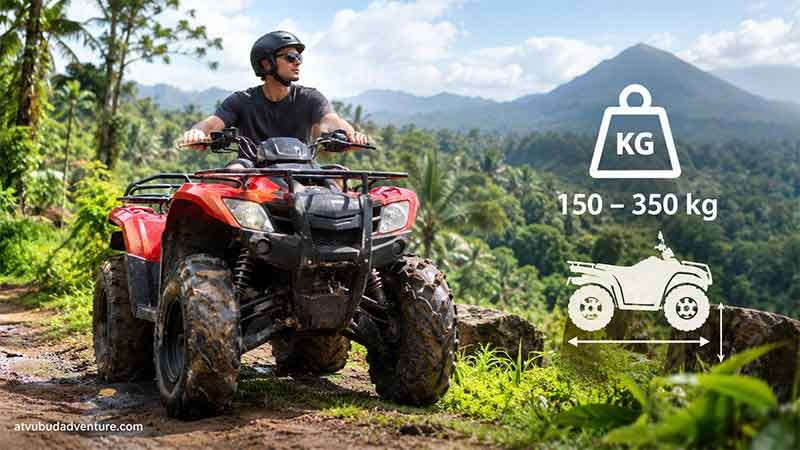
If you are planning an ATV ride in Bali, you may wonder, how much does an ATV weigh? Most recreational ATVs weigh roughly 150 to 350 kg, depending on the engine size, frame, drivetrain, tires, fuel, and equipment. Smaller recreational quad bikes can be considerably lighter, while larger utility and high-performance models may weigh more.
Knowing the weight of an ATV is useful for more than satisfying curiosity. It can help you understand how the vehicle behaves on mud, slopes, rocks, and other off-road terrain.
How Much Does an ATV Weigh?
The weight of an ATV varies widely between models. There is no single standard weight because ATVs are designed for different purposes.
A small recreational ATV may weigh around 150 to 200 kg. Mid-size models commonly fall somewhere around 200 to 300 kg, while larger utility or performance ATVs can approach or exceed 300 kg.
The manufacturer’s specifications usually refer to dry weight or curb weight. These terms matter because an ATV becomes heavier when you add fuel, engine fluids, accessories, luggage, or other equipment.
For a rider, the important point is simple: an ATV is a substantial machine. Even a relatively small quad bike has enough weight and traction to behave very differently from a motorcycle or bicycle.
What Determines ATV Weight?
Several components contribute to the overall weight of a quad bike.
Engine Size and ATV Weight
Engine size is one factor, although it does not determine weight by itself. A larger engine often requires additional components and a stronger chassis, which can increase the overall mass.
For example, a 250cc ATV and a 350cc ATV may have different weights depending on their individual designs. Engine displacement alone should not be used to predict the exact weight of a particular model.
If you are comparing these engine classes, this guide to 250cc vs 350cc ATVs can help explain the practical differences.
Frame, Suspension, and Tires
The chassis, suspension system, wheels, and tires can add significant weight. An ATV designed for rough terrain needs enough strength and suspension travel to handle uneven surfaces.
Large off-road tires also contribute to weight. Mud-oriented tires, heavy-duty suspension components, winches, racks, and protective equipment can make an ATV considerably heavier than a basic recreational model.
2WD vs 4WD
The drivetrain is another important factor. A 4WD ATV generally has additional mechanical components compared with a 2WD model.
That can increase weight, although the exact difference depends on the vehicle. For recreational riding, the drivetrain also affects how the ATV delivers traction on slippery or uneven ground.
Does ATV Weight Affect Riding?
Yes. ATV weight influences how the machine feels when accelerating, braking, turning, and riding across uneven terrain.
A heavier ATV can feel planted on the ground, but its mass also becomes important when navigating tight turns or steep sections. Momentum matters too. Once a heavy vehicle starts moving, the rider needs to control it smoothly rather than relying on sudden movements.
This is particularly relevant on muddy trails. If you want to understand what can happen when traction becomes a problem, read about what happens if an ATV gets stuck.
Does ATV Weight Matter for Beginners?
It can, but the number on the specification sheet is not the only thing that matters.
A beginner should also consider the ATV’s controls, seat position, automatic transmission, riding environment, and whether a guide provides instructions before the tour. A heavier ATV can still be manageable when the rider uses smooth steering, controlled acceleration, and proper braking.
If this is your first quad bike experience, you may also want to read do you need experience for an ATV tour in Bali?.
How Much Does an ATV Weigh With a Rider?
The total operating weight is higher than the ATV’s listed weight because you also need to account for the rider.
For example, if an ATV weighs 250 kg and the rider weighs 70 kg, the combined vehicle-and-rider mass is approximately 320 kg before considering fuel and additional equipment.
This matters when discussing performance, braking, traction, and load capacity. Manufacturers normally provide specific limits for maximum rider and cargo loads, so those specifications should always take priority over general weight estimates.
ATV Weight and Riding in Bali
Bali’s ATV tours can involve a mixture of surfaces, including dirt tracks, muddy sections, uneven ground, and other off-road terrain. The exact route depends on the tour operator and location.
Because of this, the ATV’s weight is only one part of the riding experience. Tire condition, traction, ground clearance, suspension, rider technique, and weather can all affect how the vehicle handles.
If you are curious about the surfaces used during a Bali adventure, see this guide to what kind of terrain is used for ATV Ubud tours.
Is a Heavier ATV Better?
Not necessarily.
A heavier ATV may offer a more substantial feel, but heavier does not automatically mean safer, faster, or better. The right ATV depends on the rider, the terrain, the vehicle’s design, and the purpose of the ride.
For tourists, the quality of the ATV, maintenance, safety equipment, guide instructions, and suitability of the route are often more useful considerations than simply choosing the heaviest machine.
ATV Ubud Adventure in Bali
If you want to experience quad biking in Bali, ATV Ubud Adventure offers ATV tours in Ubud, Bali. You can ask about available ATV options, riding packages, and tour details before booking.
For information or reservations, contact +6287877066948 by phone, SMS, or WhatsApp, or use the chat button on the website.
Understanding how much an ATV weighs gives you a better idea of what you are riding, but the real experience comes from learning how to control the machine properly and enjoying the terrain safely.